Average Reviews:

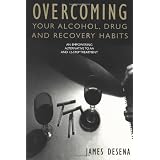
(More customer reviews)Are you looking to buy Overcoming Your Alcohol, Drug & Recovery Habits? Here is the right place to find the great deals. we can offer discounts of up to 90% on Overcoming Your Alcohol, Drug & Recovery Habits. Check out the link below:
>> Click Here to See Compare Prices and Get the Best Offers
Overcoming Your Alcohol, Drug & Recovery Habits ReviewI discovered Overcoming Your Alcohol, Drug and Recovery Habits through the author's website, which contained free sample chapters, an eye-opening self-help test to determine ones substance abuse level, fascinating facts in regard to AA and traditional 12-step treatment, and a comprehensive resources page that was laden with useful links. Of the alternative recovery books I have read, DeSena's book was most enlightening and hit home like none of the others did. For one, his replacing of the word "recovery" with "discovery" to describe post active addiction life was a breath of fresh air; very liberating. Also, his concept of "The Parasite" to describe the self-damaging self-talk all substance abusers grapple with brought rationality to this phenomenon as opposed to the irrationality that AA/12-step treatment term "the disease talking."My understanding of DeSena's material however, compels me to comment to those who find DeSena's material mirroring the Rational Recovery system developed by RR founder, Jack Trimpey. Just as similarities exist between Cognitive Behavioral Therapy and Rational Emotive Behavior Therapy, similarities exist between DeSena's and Trimpey's methodologies. And contrary to those who deem otherwise, DeSena does not claim that all his concepts are his sole creations. Rather, he states that through research, personal experience, and many conversations with those who have independently quit their addictions, he codified these addiction-ending methodologies/techniques and gave them names.
DeSena's name for the substance abuser's addictive self-talk is his metaphorical "The Parasite": "Just one won't hurt," "I gotta have it," "You can a few; just don't drive." In contrast, Trimpey presents his "Beast" as a real entity overshadowing the real you. In RR, the "Beast" is not metaphorical or symbolic. This alone is a huge concept difference.
Trimpey devised a Structural Model of Addiction to explain the addictive thinking process and addictive behavior. DeSena explains his model in physical terms through his Dual-Mind Cycle of Addiction. Unlike Trimpey's process, which involves separating the brain into two distinct entities-the neocortex (new brain) and the midbrain, (the beast brain)-DeSena takes us through this thinking process using corporal expressions involving the emotional brain, emotional mind, rational mind and rational brain. Again, this is a vast concept difference and in stark contrast to those who view DeSena's material analogous to Trimpey's. For me, DeSena's empirically valid explanation brought clarity to this often ill explained thinking process, (though Trimpey's explanation is valid and helpful, too). It also laid a solid foundation for applying the addiction-ending self-help techniques that followed.
There are only so many ways to explain cogent methodologies, which help undecided/ambivalent substance abusers make the decision (or to help those who have made the decision) to never drink or abuse other drugs again. In other words, a plethora of verbiage does not exist to describe, "never," or to describe the substance abuser's hesitance, (ambivalence) to make the decision to quit for good. Surely, certain points will overlap with the different methodologies. DeSena's methodology manifests through his Parasite Awareness, Warning, and Neutralize process, P.A.W.N. DeSena ties P.A.W.N. into the easily understood Dual-Mind Cycle of Addiction-a cycle which traces the substance abuser's addictive thinking process to the rational brain's verbalizations of addiction, survival, craving and pleasure messages such as: "Time for a drink," "I need it," and "I want it." Trimpey presents comparable methods through his Addictive Voice Recognition Technique, AVRTsm. While AVRTsm is designed to expose the "addictive voice," it exposes the addictive voice as the verbal manifestation of an actual internal Beast. Once more, it is clear that DeSena's metaphorical Parasite is far removed from Trimpey's real internal Beast. Nonetheless, both processes are viable alternatives to AA's largely ineffective 12-step method and 12-step treatment as promulgated via the majority of America's rehabs and addiction treatment providers in private practice.
I give DeSena's book, Overcoming Your Alcohol, Drug and Recovery Habits, 5 stars. I give Trimpey's book, Rational Recovery, 5 stars. Read them both and appreciate their differences, yet also value their harmony. Most importantly, whether you favor DeSena's Parasite metaphor and P.A.W.N. method, or Trimpey's Beast entity and AVRTsm system, these two books will doubly arm you to help yourself overcome your self-destructive addictive behavior.
Overcoming Your Alcohol, Drug & Recovery Habits Overview
Want to learn more information about Overcoming Your Alcohol, Drug & Recovery Habits?
>> Click Here to See All Customer Reviews & Ratings Now

0 comments:
Post a Comment